
NATURAL COMPOUNDS HISTORICAL BACKGROUND
Synthesis of natural compounds and bioactive congeners
(principal researchers, prof. Francesco De Riccardis and prof. Irene Izzo)
At our Organic Synthesis laboratory, the partial or total synthesis of over twenty compounds, including natural products and their analogues, some of which have potential anticancer and anti-inflammatory activity (Figure 1), has been carried out. In particular, the focus was directed toward the class of steroids and peptides, compounds that are essential to every living organisms. From a structural point of view, the most challenging task was the synthesis of azumamides, as evidenced by the cover of the journal Angewandte Chemie International Edition (Figure 2).
Figure 1. Significant examples of compounds synthesized.
Figure 2. Cover on Angewandte Chemie.
Synthesis of new steroidal and calixarene species as membrane pores
In recent years, many research groups have dedicated their attention to the design and synthesis of compounds capable of behaving like membrane pores. This interest is justified by the fact that many antibacterial and antifungal drugs work by disrupting the chemo-osmotic balance of the plasma membrane of microorganisms, thereby inducing the death of the pathogens.
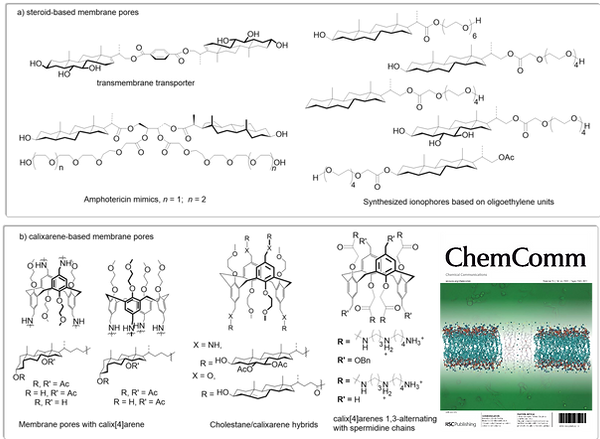
In this context, the design and synthesis of a polyhydroxysteroid dimer (which proved to be an efficient sodium transmembrane transporter) and the synthesis of compounds based on a cholestane core that feature one or two oligo-(ethylene glycol) units necessary for the exchange of electrolytes present both inside and outside the plasma membrane (Figure 3a) were undertaken. In these cases, the ion transport activity was comparable to that observed in amphotericin, a potent antifungal. The design and synthesis of a new class of compounds that feature a calix[4]arene core (Figure 4b) has generated several structural congeners, some with potent antitumor activity, enough to receive the cover of the Chemical Communications.
Figure 3. Synthesis of new steroidal and calixarene species with membrane pore activity


Novel stereoselective methodologies in organic synthesis
(principal researcher, prof. Giorgio Della Sala)
The chemical-physical properties and the biological activity of chiral molecules are strongly affected by their absolute and relative configuration. It follows that stereoselective catalysis, the area of research that studies and exploits the property of catalysts to control the configuration of reaction products, is of paramount importance in various industrial fields such as pharmaceutical, agrochemical, food, polymer and others. Although the second half of 20th century was dominated by transition-metal based catalysts, the increasing demand for environmetally benign processes encouraged, since the turn of the millenium, the extraordinary development of metal-free techniques such as organocatalysis and phase-transfer catalysis (PTC).
In this context, our efforts are directed to the development of novel organocatalyzed and phase-transfer catalyzed methodologies, with an eye on reduction of environmental impact, costs and energy consumption.
Catalytic macrocyclic peptidomimetics and derivatives
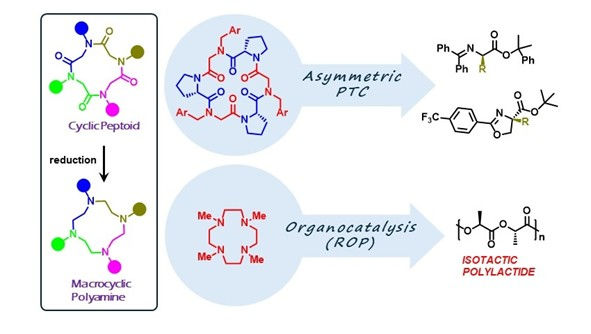
Cyclic peptoids (N-alkyl-glycine cyclic oligomers) are conveniently accessible through versatile solid-phase transfer methods, controlling the ring size and the structure of single monomers. We first demonstrated that cyclic peptoids behave as effective phase-transfer catalysts (Org. Biomol. Chem., 2013, 11, 726), and later we reported the enantioselective PTC alkylation of a-amino acid derivatives (J. Org. Chem., 2016, 81, 2494; Eur. J. Org. Chem. 2014, 7793; Synthesis, 2017, 49, 1319).
Cyclic peptoids are also useful precursors of macrocyclic polyamines. We demonstrated that the latter are valuable catalysts for the ring-opening polymerization (ROP) of lactide (Catal. Sci. Technol., 2025, 15, 71).
Stereoselective synthesis of phthalides
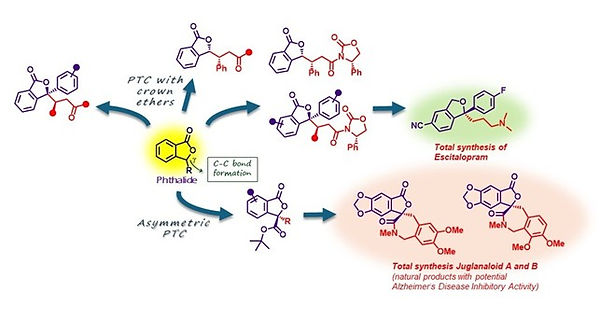
Phthalides are characterized by an aromatic lactone bicyclic motif that is incorporated into the structure of many natural products and analogs exhibiting relevant biological activity. During our studies we developed efficient methodologies, mainly based on PTC, for the stereoselective formation of C‒C bonds at the γ-carbon of the lactone ring (Org. Lett., 2017, 19, 4383; Chem. Eur. J., 2019, 25, 7131; J. Org. Chem., 2020, 85, 7476), which were then applied to the enantioselective synthesis of related secondary metabolites and drugs (Adv. Synth. Catal., 2024, 366, 1636; J. Org. Chem., 2024, 89, 7255).
Stereoselective synthesis of fluorine-containing compounds
The interest in the synthesis of fluorine-containing compound has grown exponentially in recent decades, with industrial applications in the areas of materials, pharmaceuticals, cosmetics and agrochemicals. The development of novel strategies for the regio- and/or stereoselective introduction of fluorinated functional groups is an hot topic in organic synthesis today. Our efforts led to the enantioselective trifluoromethylthiolation of alpha and beta-amino acid derivatives (Org. Lett., 2020, 22, 219; Org. Biomol. Chem., 2020, 18, 2914).
Other organocatalyzed and phase-transfer catalyzed reactions
Other works in asymmetric organocatalysis have involved the desymmetrization of meso-aziridines (Org. Lett., 2009, 11, 3330; Org. Biomol. Chem., 2011, 9, 6205; Tetrahedron, 2013, 69, 50), the conjugated beta-azidation of electron-poor alkenes (Adv. Synth. Catal., 2015, 357, 3365; Adv. Synth. Catal., 2019, 361, 4790), and the phase-transfer catalyzed vinylogous Michael addition of silyloxyfuran (J. Org. Chem., 2017, 82, 6629).